FROSCH Insider has a new home!

You should be automatically redirected in 2 seconds. If not, visit
http://froschinsider.com
and update your bookmarks.

Showing posts with label Africa. Show all posts

Tuesday, March 6, 2012

Outdoor Adventures: family safari with Singita

Photo: Singita
Got a case of cabin fever? It happens to all of us this time of year-- whether it's the change of seasons, or just the long stretch between holidays. Travel can be a good way to get a good dose of the great outdoors, especially if you go somewhere where nature still reigns as it has for millions of years.

Singita Game Reserves shared the photo above as a prime example of  what you might see on a family safari at Singita Sweni lodge, perched above the Sweni River in the Kruger National Park. Read more about this amazing experience on their blog.

Wednesday, November 30, 2011

Caught in the act!


Animal lovers everywhere will recognize the mischievous glint in the eyes of this lioness as she decides that this video camera, set up by Tswalu photographers to capture footage of the Kalahari wildlife, now belongs to her. What big teeth! Here's how it went down: 
Photographer Roger de la Harpe, of Africa Imagery, has been shooting at Tswalu Kalahari for his book about African lions. He wanted to get some close up shots with a small digital video camera so placed it where he knew a pride of lions would soon be passing. As expected the lions came into view. Unexpectedly, and to the horror of Roger who was watching from a distance, one of the lionesses showed an unhealthy interest in the camera. She licked it, gave it a good sniff and then picked it up in her mouth and ran off with it (Via Tswalu Kalahari Blog)
Incidentally, Tswalu, a private game reserve in South Africa, happens to be one of our favorite places to recommend to those looking for an amazing safari experience. It's home to the Malori Sleep Out Deck, known as "the best bed in Africa" and a luxurious outdoor loo with an incredible view. Perhaps as you shower under the stars you'll catch a glimpse of this camera-toting lioness!


Monday, April 25, 2011

On Safari - Making the little things count

by Jean Campbell

When we were young, my grandfather and my older brother bridged the gap of generations, and found a common interest in bird watching.  At the time I didn't have the maturity or the peace of mind to appreciate this hobby or understand what the appeal was.   It was only years later, while sitting in a vehicle in the wilderness of Africa, that I came to comprehend what a wonderful world was out there in clear sight once I was able to see beyond the obvious.  

I admit I first had to get over the excitement and anticipation created when looking for, and then finding the big game; still a wonderful awe inspiring experience every time. Once I realized, however, that every moment on safari does not have to be spent on a wave of adrenalin, I turned my attention to the smaller things in life as pointed out by the guides.   Watching the birds and  butterflies; learning about the plants; understanding connections between the animal world and the plant kingdom, and other such subjects became the focus. With that came a true learning experience right there in the classroom of the outdoors; the guides being our teachers.  What better opportunity is there!  This trip was no exception, and again we were impressed by the many facets nature has to offer, and again she did not fail to deliver.


Whistling Thorn and Cocktail Ants.
In what other setting would we learn about the whistling thorn (an acacia tree) so called because in addition to the long thorns the acacia is known for there are also, what are called stipular spines, and at the base of each of these stipular spines is a 1 inch swelling.  These swellings are home to four different kinds of ants who pierce the swellings, creating holes.  When the wind blows through the holes serve as a flute, and produce a whistling sound.  


Butterflies (Papilio demodocus)
I read somewhere there are 1370 species in Tanzania. These are just the common variety but they are still so beautiful to look at.   I didn't know, in spite of the very dramatic markings often found on butterfly wings, the wings are actually transparent.  

Yellow fever tree
Early explorers or pioneers were under the false impression that the yellow fever tree actually caused fever.  The issue was not the trees themselves but the swampy area in which the trees grow that was the problem.  The swampy environment that the trees thrive in is also an ideal breeding ground for mosquitoes, which of course, carry malaria.  The tree however got the blame first, and the name stuck.  

White Backed Vulture
Despite the perception that the vulture is a scavenger, and therefore can be perceived as nasty and dirty they are actually among the cleanest birds; often bathing and preening carefully after eating. 

Kori Bustard – The Kori Bustard is one of the largest flying birds, though it doesn't do it very much flying. The male Kori Bustard averages about 3½ feet in length, stands 2-3 feet, tall and has a wingspan about 7½ - 9 feet.  That’s a big bird!


Whistling Thorn and cocktail ants – Ol Donyo Lodge
Butterflies – Lake Manyara Tree Lodge and Gibbs Farm
Yellow Fever Tree – Ngorongoro Crater Lodge
Kori Bustard Grumeti River Lodge
White Backed Vulture – Klein’s Camp

Thursday, April 7, 2011

Up Up and Away - ballooning over the Serengeti


by Jean Campbell

The day of our balloon safari started very early from the wonderful &Beyond Under Canvas camp, and due to a last minute (weather/wind related) change of venue it took us an hour or so to get to the “lift off” point, but it was an entertaining drive nonetheless. After the balloon ride it was about a 45 minute drive through the Serengeti to get to the breakfast spot (no stopping and loitering on this drive).  Upon arrival we were greeted by a hand washing attendant, as well as “facility” with a view.  Breakfast was a yummy and enjoyable occasion, followed by the opportunity to visit the “gift shop” before heading back to camp.

From our horizontal boarding to our smooth upright landing we were able to enjoy sunrise, zebra, cheetah, wildebeest, hyena, bat eared fox, and the never ending plains of the Serengeti; all from an altitude ranging from 1600 feet, down to 1 foot (my perspective wasn’t off) with our pilot Frank narrating along the way.


Loosely translated, the history of ballooning, as told to us, takes shape in 1783 in France.  The idea of the balloon came about when two brothers Joseph-Michel and Jacques-Etienne Montgolfier (paper manufacturers) watched ash rising when paper burned.  In September of that year a scientist, Pilatre de Rozier, launched a balloon carrying a sheep, a duck and a rooster; the idea was to record the reactions of each when flying at altitude.  The balloon stayed up for about 15 minutes before crash landing; we were told all of the “passengers” lived.  This made way for the first human flight two months later.  The honor of flying it was initially going to be imposed on convicted prisoners however the thought was if it was successful then they would be heroes.  Instead Pilatre de Rozier and Marquis Francois d’Arlandes petitioned for the role and piloted the flight, which was successful (staying up for about 20 minutes) before coming down in a farmer’s field.


These balloons were very crudely designed at the time; there was an fire built on a grill attached to the bottom of the balloon making the balloons very susceptible to catching fire.  Of less concern, but as it turned out almost as dangerous, was the fact that anyone in the balloon got completely covered in soot from the fire.  Upon landing the inhabitants of this first balloon (completely blackened by the soot) were mistaken for demons, and almost killed by the farmer whose field they landed in.  Consequently on future flights the pilots were given a bottle of Champagne.  The idea being; when they landed (blackened) they would be able to present the farmer with the Champagne, thereby proving that no matter how they looked, they were in fact bonified Frenchmen and not demons.  So was born the idea of the champagne breakfast served to us at the end of our wonderful balloon safari over the Serengeti. 

(Note: This type of balloon was called the Montgolfiere balloon after the two brothers.  Later the hydrogen balloon was introduced; and following that, in the 60’s, the army created the style known today.  As I mentioned, this is the loose translation of the first manned balloon flight, any inaccuracies can be completed blamed on the champagne served at breakfast.)


Wednesday, March 30, 2011

Klein’s Camp, Serengeti, Tanzania – &Beyond

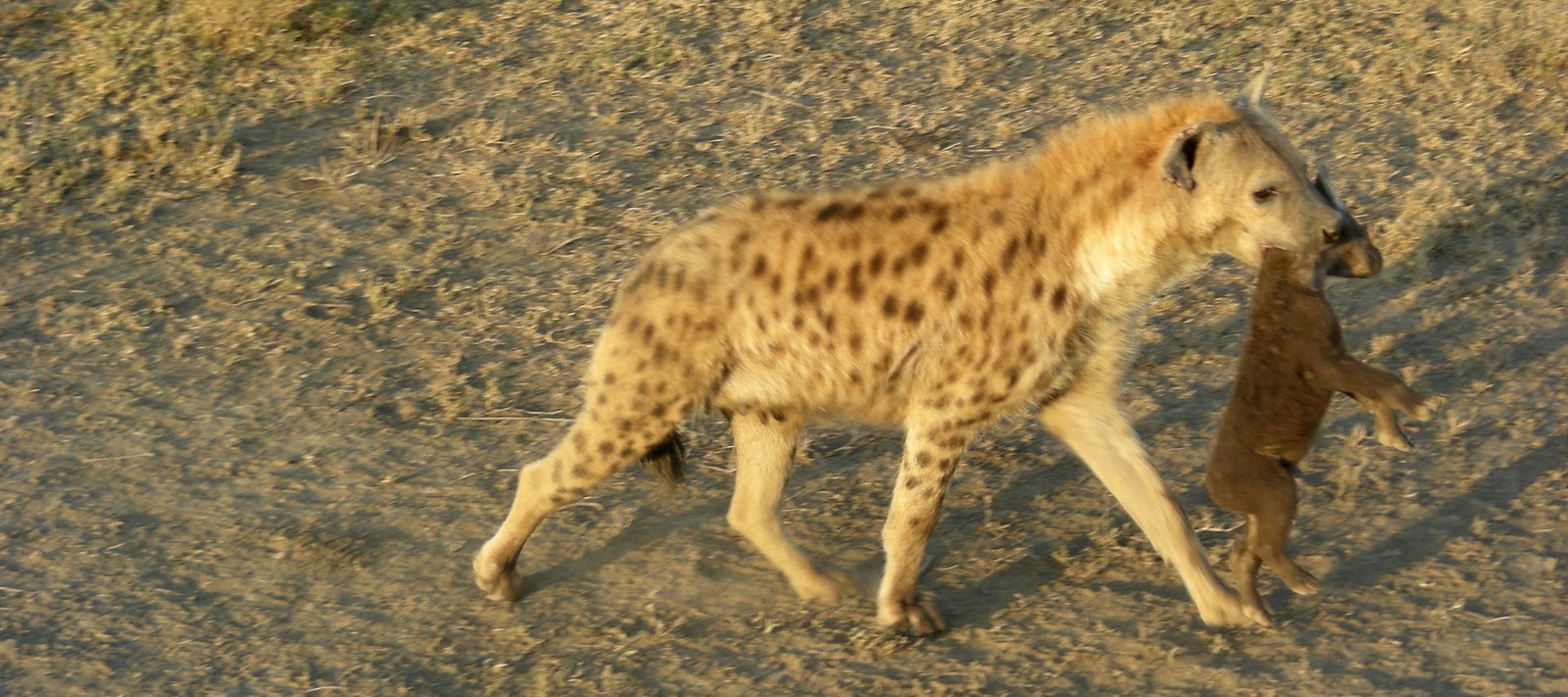
a mother hyena gently carries her cub to a new location

by Jean Campbell 

We woke up to the wonderful sounds of a hyena “drama” in full swing; it went on for a number of minutes escalating in excitement to (what seemed to be) hysterical proportions before calming down to the more subdued “chatter” of the now familiar hoots and whoops.  What a glorious and absolutely insane sound to wake up to; such was our morning wake up call during a recent stay at Klein’s Camp, the wonderful &Beyond property located in the Serengeti (Tanzania), on the edge of the Kuka Hills.


The elevated location of the camp allowed us an undisturbed view of valley floor below, and we watched these superb creatures (viewed as superbly ugly by many) run riot as they tried to regain order in their world.  The guide later told us that there had been a lion kill (zebra?), and two hyena packs had converged to steal the kill only to end up squabbling over which pack would ultimately take the prize. One pack consisted of about 19 hyenas, the other around 16, so there was a lot of very heated “discussion” going on among them all as hierarchy was established. 


In total it is thought that the hyena produces about 14 different sounds depending upon the situation.  The most identifiable of these must be the “whoop” and the “laugh” that we experienced that morning.  The “whoop” sound starts low, and modulates up and down in pitch; amazingly, it seems, each hyena has their own unique version of this sound.  It is used to communicate and identify when visual contact is not possible; it is also used when an animal approaches a new clan in order to announce their presence, and prepare for possible rejection.  We also enjoyed some great versions of the “hoot laugh” (much to my joy); hence the name “laughing” hyena.  Apparently this sound is produced at a time of uncertainty when the animal is conflicted between approaching or departing from a situation (“should I stay or should I go”).  This can also be the sound made by a submissive animal as it waits their turn at a kill, as well as when this lower ranking member is chased from the kill by a superior ranking animal.  In addition there are apparently higher or lower pitch versions of this sound that will change the meaning.

The hyena may not appeal to everyone, and certainly it could be argued that they have a face only a mother could love, but I do love to see and especially hear these animals.   These are the moments that touch my soul; these are the moments of relative simplicity that illuminate to me the beauty, and the complexity of nature, and for just a moment it is a glimpse directly into the wild and something very pure and raw; something very special.  What an absolute privilege!
Related Posts Plugin for WordPress, Blogger...